


Auto Drill: Galaxy
4.3371.00 Reviews
App Specs
- Version
- 25
- Updated On
- License
- Free
- Downloads
- 100,000+
- Developer
- LAVA LABS OYUN YAZILIM VE PAZARLAMA ANONİM ŞİRKETİ
- Categories
- Strategy
- Platform
- Android
Screenshots


 Analysis by AppCompare
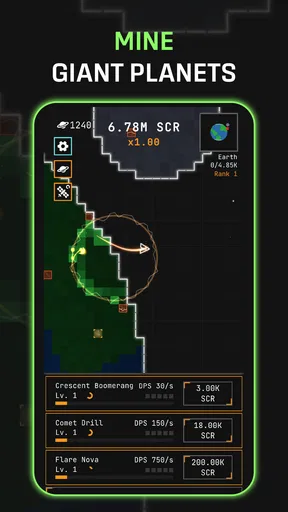
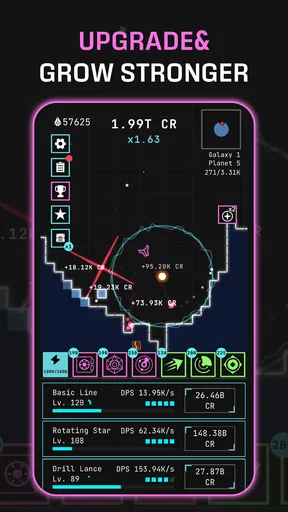
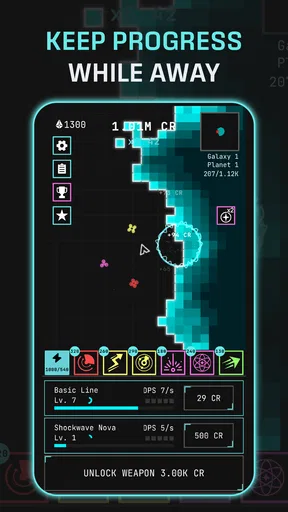
Auto Drill: Galaxy has a simple hook: keep drilling through a planet, make choices about weapons and skills, and see how far your setup can carry you. I find that combination appealing because it puts the action on autopilot without making every decision feel automatic. The central pleasure is tuning a build, then watching it handle the next stretch of blocks. It is a strategy game for short bursts, though its appeal depends on enjoying gradual progress more than hands-on, moment-to-moment control.
A quick way to tell whether its pace suits you
The key question is not whether you like drilling as a theme, but whether you enjoy shaping a system and then observing what your choices do. I would give the game a short trial with one clear goal: pay attention to whether choosing weapons and combining skills feels satisfying in its own right. If you keep thinking about how to improve the setup between check-ins, the loop is probably working for you. If you only want the automatic progress to hurry along, the format may not have enough active play to hold your attention.
That distinction can help avoid a common mismatch with idle-leaning games. They can look like something to leave running, but the interesting part here is the decisions around the drill, not simply having an activity on screen. I would treat each visit as a chance to assess the build and choose a direction, rather than expecting a deep session of continuous input.
Where the strategy sits in an automated drill
The game’s auto-drilling premise sets expectations clearly. You are not being asked to treat every block as a puzzle requiring precise timing; instead, the strategic interest comes from improving the tools doing the work. Weapons and fused skills give that progression a layer of choice, so the question becomes less “Can I tap quickly enough?” and more “Have I assembled a combination that keeps working as the challenge grows?”
That distinction matters when comparing it with other strategy games. It is not the kind of experience I would pick for deep tactical planning across a map, careful unit positioning, or a long match against another player. Its strategy is closer to build management: make decisions about how your automated progress develops, then judge the results. If you enjoy tinkering with upgrades and seeing a setup become more effective, that is a good fit. If you want every action to demand active input, the automated structure may feel too hands-off.
The best part of this design is that a brief session can still have a purpose. I can check how a run is going, consider whether a weapon or skill direction suits my current approach, and leave once I have made meaningful progress. It is less demanding than a conventional strategy session, which makes it easier to fit around small gaps in the day. The trade-off is that the satisfaction comes from cumulative improvement rather than a dramatic tactical moment.
Build choices matter more than frantic tapping
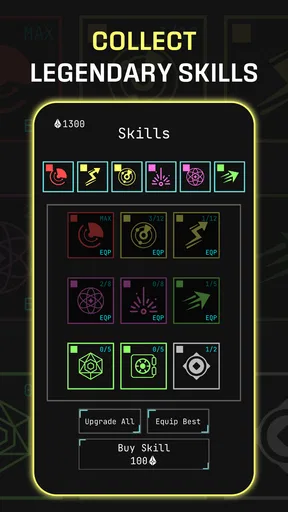
Weapons and skill fusion are the ingredients that give the drilling loop its strategic identity. A useful way to approach them is to think in terms of a coherent build rather than treating every available improvement as equally valuable. When a game offers both weapons and skills, it is tempting to spread attention around; I would instead watch for combinations that reinforce the kind of progress I want from a run. That makes each choice easier to evaluate, even without turning the game into homework.
Worth Reading Before You Choose

EA SPORTS FC Mobile 26 Is a Bigger Football Game, but It Takes Time

Flipboard Shows What News Apps Must Do Beyond the Feed

Switching to Android Auto Means Rethinking Your Driving Routine

Google Calendar Makes a Crowded Week Easier to Manage

Ludo King Makes the Most of the Minutes Between Plans

Baby Panda World Brings Quick Play to Modern Phones, but Its Game Library Feels Busy
One practical habit is to pause mentally after a notable upgrade and ask what it changes about the next stretch, not just whether it looks powerful in isolation. A fused skill may be most useful when it complements the weapon choices already doing work for you; a weapon that seems attractive on its own may be less compelling if it pulls a build in a different direction. This is a general decision-making tip rather than a claim about hidden mechanics: the game’s stated emphasis on weapons and fused skills rewards paying attention to how choices fit together.
There is also a useful distinction between a run that feels strong now and a setup that seems worth developing. If immediate progress is your only measure, you may keep making whichever choice offers the quickest visible result. If you are curious about the longer arc, it can be more satisfying to settle on a direction and see whether its parts combine well. That small shift gives an otherwise automated game a personal experiment: you are not merely watching blocks disappear, but testing a build philosophy.
The appeal—and limit—of watching progress unfold
Automation is a strength when I want a low-pressure game, but it is also the clearest possible limitation. Players who enjoy direct control may find themselves wishing they could influence every drilling moment rather than focusing on setup and progression. The game’s premise does not promise a constant stream of precise actions, so I would not recommend it as a substitute for an action game or a highly interactive tactics title.
There is a second trade-off in any progression built around repeated improvement: if the pleasure of upgrades wears off, the underlying activity can feel repetitive. The question for a prospective player is whether the cycle of unlocking weapons, combining skills, and pushing farther sounds satisfying even when the basic task remains familiar. I think it will for people who like incremental optimization. Someone who needs a new puzzle or a sharply different objective every session may tire of the loop sooner.
That makes it important to judge the game on its own terms. Its most promising moments are likely to come from noticing that a considered combination has changed the pace or feel of a run. It is not necessarily going to supply the tension of a close competitive match or the variety of a campaign full of distinct scenarios. I would treat it as a compact progression game to dip into, not as a deep strategy commitment that must hold attention for long stretches.
A sensible way to fit it into everyday play
For an everyday example, imagine having a few minutes while waiting for a kettle or sitting between appointments. This is the kind of game I would open when I want to make one or two progression decisions and watch the drill continue without needing to keep both hands and full attention on the screen. I would avoid starting it when I want an absorbing activity that keeps me focused on a sequence of precise inputs; its automated rhythm is better suited to casual check-ins.
A second useful approach is to use short sessions to compare the direction of a build rather than chasing progress without reflection. Notice which weapon and skill choices you have made, then decide whether the next opportunity should support that direction or change it. This keeps the strategic layer active even when the drilling itself is automatic. It also helps reveal whether the game’s core loop genuinely suits you: if choosing and refining a setup is enjoyable, the format has room to work; if those decisions feel like chores, more time may not fix that mismatch.
Because it is free to play and includes optional in-app purchases, I would begin by treating the purchase options as a choice rather than a requirement. The listed item range runs from $1.99 to $99.99, a broad spread that makes it sensible to decide what you are comfortable spending before browsing offers. You can first see whether the basic loop holds your interest, then consider spending only if a particular purchase feels worthwhile to you. That is a more reliable test than assuming a purchase will solve repetition or make an unsuitable play style enjoyable.
Small-session habits that make the choices clearer
I would also avoid changing several parts of a build at once when trying to understand why a run feels better or worse. Make one deliberate adjustment, then give it enough time to judge its effect before shifting direction again. Because the drilling continues automatically, it is easy to lose track of which decision actually helped; a simple mental note about the weapon or skill you chose can make later choices more intentional without needing a spreadsheet or a strict plan.
Another useful trade-off is deciding when to experiment and when to consolidate. If a setup has begun to feel coherent, continuing to replace pieces just because a new option appears can make it harder to learn what the current combination is doing. On the other hand, sticking stubbornly to one idea can limit discovery. I would use a stable direction as a baseline, then test a change when there is a clear reason, rather than treating every choice as a reset.
Who will enjoy it, and who should look elsewhere
I would recommend this to players who like idle-leaning progression, build experimentation, and strategy that can be enjoyed in short sessions. It is especially suited to someone who likes observing the consequences of a setup and making occasional adjustments, rather than issuing constant commands. If you enjoy the planning side of games but often lack time for a full match, the automated drilling format offers a lighter alternative.
I would steer away from it if you are looking for a substantial tactical campaign, multiplayer competition, or action that depends on precise reflexes. Those are not the strengths suggested by its central loop. A traditional strategy game is a better choice when you want consequential decisions every moment; an action game is better when the satisfaction comes from direct control. Auto drilling occupies a narrower space between those expectations, and that is a strength only if you want exactly that kind of low-pressure progression.
It is also a reasonable option for players who prefer free entry before deciding whether a game deserves more of their time. The game is rated for Everyone, and the store shows a 4.4 average from around 1.3 thousand ratings. That offers useful context, but I would not treat popularity as proof that the pace will suit you: the automated format remains a matter of personal taste. The game has over 50 thousand installs, while its audience size does not change the central question of whether you like build-focused play.
Availability and the final call
The game is a free strategy title from LAVA LABS OYUN YAZILIM VE PAZARLAMA ANİM ŞİRKETİ. It is marked for Everyone, runs on Android 7.0 or later, and its current version is 20. Its release date is listed as June 24, 2026. Those details make it straightforward to check basic compatibility and age suitability before installing, while the optional purchases are worth keeping in mind if you prefer to avoid spending inside games.
My verdict is that Auto Drill: Galaxy is a promising fit for casual players who want to shape a build and let it do the steady work. Its strongest quality is the contrast between automated drilling and player-led decisions about weapons and fused skills. Its main weakness is the same design viewed from another angle: people who need direct control or substantial tactical variety may find the loop too passive. I would try it for short sessions, make deliberate choices about a build, and continue only if watching that setup develop feels rewarding.
Auto Drill: Galaxy is at its best when you approach it as a small strategy ritual rather than a demanding challenge. It gives you a clear reason to return—refine your choices and see what they can do—without pretending that every player will enjoy watching progress unfold. If that sounds relaxing and satisfying, it is worth a look; if you want constant action or intricate planning, another game in the strategy category will likely suit you better.
Pros
- Simple controls make it easy to start drilling and collecting resources.
- The space-mining theme offers a fun change from typical idle games.
- Short play sessions suit casual play during breaks.
- Progression gives you clear goals as you upgrade your operation.
- The core gameplay is easy to understand without a steep learning curve.
Cons
- Idle-style progress may feel repetitive after extended play.
- Upgrades can take time to earn
- especially as progress slows.
- The gameplay may offer limited variety for players seeking active challenges.
- Frequent prompts or ads may interrupt the experience
- depending on the version.
- Its simple mechanics may not hold the interest of players who prefer deeper strategy.
FAQs for Auto Drill: Galaxy
What is Auto Drill: Galaxy?
Auto Drill: Galaxy is a space-themed incremental game built around drilling, gathering resources, and improving your equipment. You progress by sending drills deeper into the galaxy, collecting materials, and using them to unlock stronger upgrades and new areas. Its automated progression means some tasks continue without constant input, while upgrade choices give you reasons to check back and decide how to develop your operation.
Is Auto Drill: Galaxy free to download and play?
The game may be available to download for free, but the exact price and any optional purchases can vary by platform and region. Free-to-play games can offer in-app purchases for items, boosts, or other progression aids, and advertisements may also be present. Before downloading, check the current App Store or Google Play listing for pricing, in-app purchase details, and any advertising disclosures.
Does Auto Drill: Galaxy require an internet connection?
Whether you can play Auto Drill: Galaxy offline may depend on the version and on features that connect to online services. Core drilling and upgrade gameplay may be accessible without a connection, but events, cloud saves, advertisements, or purchase verification can require internet access. Check the store listing and test the game on your device if offline play is important, especially before relying on it while traveling.
Is Auto Drill: Galaxy suitable for children?
The game’s space setting and incremental mechanics may appeal to a broad audience, but suitability depends on its content, advertising, and purchase options. Age ratings can differ between Android and iOS and may change over time. Parents should review the current store rating, privacy information, and in-app purchase disclosures, and consider enabling device-level purchase controls before allowing a child to download or play.
Will Auto Drill: Galaxy run on my Android or iOS device, and will my progress transfer?
Compatibility depends on your device model, operating-system version, available storage, and the requirements shown on the game’s current store page. Check those details before installing, since requirements can change with updates. Progress transfer between devices or between Android and iOS is not guaranteed; it may depend on cloud-save or account features. Confirm that the game offers a supported backup method before changing devices or reinstalling.


